
What the Department of Finance’s newly adopted rules—19 RCNY Chapter 62—mean for owners of high-value New York City second homes.
Overview
On May 28, 2026, New York State enacted a surcharge—commonly called the “pied-à-terre tax”—on Class 1 homes valued at $5 million and Class 2 homes (i.e., condominiums and cooperative residences (“co-ops”)) valued at $1 million (the values used for New York City real property tax). SAX covered the pied-à-terre tax (“PAT,” “tax,” or “surcharge”) in our June 5, 2026 tax alert. This supplemental alert addresses New York City Department of Finance (“DOF”) adopted PAT rules and related official policies, including key dates (July 25 and August 30), how the surcharge will be administered, and how owners can claim or defend a primary residence exemption. Primary residences are exempt from the tax regardless of value.
Key Takeaway
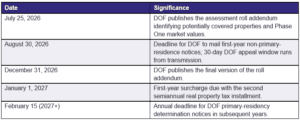
For the 2026/2027 fiscal year, DOF will mail notices for properties it treats as non-exempt no later than August 30, 2026, based on the assessment roll addendum published on July 25, 2026. Owners have only 30 days from the notice date to appeal through DOF’s online portal. Alternatively, a taxpayer can appeal to the NYC Tax Commission.
How DOF Will Make and Communicate Determinations
For the 2026/2027 fiscal year, DOF will use income tax data and existing property tax exemption information to decide whether a property appears to be a primary residence. The determinations will be included in the assessment roll addendum published on July 25. Notices for properties treated as non-exempt will be mailed no later than August 30, 2026. Each notice should include the projected surcharge, the appeal deadline, and instructions for filing an appeal. In later years, notices are due by February 15 and may be sent electronically. Potentially impacted parties (New York City property owners, co-op owners, cooperative boards, condominium boards, management companies, etc.) should examine the assessment roll addendum as soon as possible because the PAT appeals deadline is only 30 days after the August 30 notice date. Learn more: https://www.nyc.gov/site/finance/property/property-assessments.page
Key Date and Compliance Timeline
Entity Ownership Is Construed Strictly
- Entity ownership rules are strict. DOF will not automatically treat an individual as the resident owner just because the individual owns part of an entity that owns the home. The entity generally must hold the entire relevant property interest, and the resident owner or owners must hold a majority interest.
- Majority ownership can be combined. Multiple owners may be able to combine their interests to meet the majority-ownership requirement, but the people whose ownership is counted must be the primary residents.
- Tiered entities are a problem. An individual cannot establish primary residency through multiple layers of entities.
Trust Ownership
- Trust ownership: sole beneficiary. For a trust-owned home, the primary resident generally must be the “sole” current beneficiary. The sole current beneficiary can include multiple primary residents (e.g., spouses, children, etc.). Future or contingent interests are disregarded from the sole-beneficiary analysis.
Leases and “Arm’s Length” Transactions
- Leases must be real, arm’s-length arrangements. DOF may reject leases entered into mainly to avoid the surcharge.
- Only individuals can be primary residents. An entity cannot establish primary residency as a tenant.
The Taxable Status Date Controls Primary Resident & Valuation Determinations
- The key facts are measured on January 5. The DOF will look at value and primary residence status as of the January 5 taxable status date for the fiscal year. Changes subsequent to January 5—such as a new lease, renovation, or planned future occupancy—will not change the result for that year.
- No partial-year relief. The PAT is not prorated for partial-year primary residence use.
Hardship Continuation and Self-Disclosure
- One-year continuation. The rules deem an individual’s primary residency to continue for one year following death, or during continuous hospitalization or a temporary nursing home or rehabilitation stay, with appropriate proof.
- Voluntary self-disclosure. The rules allow an owner to disclose in writing that a property does not serve as a primary residence.
Appeals Forum
- Written appeal; strict 30-day window. The DOF appeal is a written process through an electronic portal—there is no hearing. Failure to timely appeal generally converts the initial determination into a final, unchallengeable determination, subject to limited statutory exceptions. Note that DOF cannot reduce the assessed value; that authority resides with the NYC Tax Commission.
- Tax Commission filing preempts the DOF appeal. If an owner challenges an initial primary-residency determination with the NYC Tax Commission, DOF will not consider a parallel appeal—and any DOF determination has no effect.
Appeals: Acceptable Proof
- Tax return: A recently filed state or federal personal income tax return showing the property as the permanent home address; or
- Two-document alternative: Two or more acceptable documents, such as a current government-issued ID showing the address, a NYC voter identification card, or other proof acceptable to DOF. A voter card alone is not enough.
- Additional proof for special situations: More documentation is needed when the primary residence claim depends on a family member, tenant, entity, or trust. Examples include marriage certificates, leases and rent records, entity agreements and affidavits, or trust documents and trustee affidavits.
Cooperative Corporations and Liens
- Building-level lien; proprietary lease amendments advised. DOF will list co-op units that are subject to the PAT in the assessment roll addendum published on July 25, 2026. However, the surcharge is billed to the co-op corporation and constitutes a lien on the property as a whole. This effectively makes co-ops the collectors and guarantors of shareholder liability. DOF has suggested that co-ops consider amending proprietary leases to include co-op authority to collect unpaid PAT from shareholders attributable to the impacted co-op units.
- Liens run with the property. Because the surcharge attaches to the property rather than a particular owner, liens can reach subsequent purchasers, including on retroactive impositions. DOF pointed buyers and sellers to transactional documents—representations, escrows, and indemnities—to allocate this risk.
Penalty Framework
DOF may impose penalties if an owner submits materially inaccurate or misleading information negligently or in bad faith, or if a condominium structure is used in bad faith to avoid the surcharge:

What to Do Now
Affected parties should prepare now, before the August 30 notice arrives. We recommend the following steps:
- Identify potentially covered properties. Review NYC one-, two-, and three-family homes, condominiums, and co-op apartments that may exceed the applicable thresholds, and determine who uses each property and for how much of the year.
- Review entity and trust ownership. For homes owned through LLCs, corporations, partnerships, or trusts, confirm who owns or benefits from the structure and whether the DOF rules allow that person to establish a primary residence exemption.
- Gather proof now. Collect tax returns, IDs, leases, utility bills, rent records, entity documents, trust documents, and affidavits before notices arrive so a complete appeal can be filed within the 30-day window if needed.
- Review leases carefully. If a lease supports the exemption, confirm that it is a genuine arm’s-length lease to an individual and that the supporting records are in order.
- Choose the appeal route carefully. A Tax Commission challenge can prevent DOF from considering a separate DOF appeal.
- Co-op boards: prepare for building-level billing. Evaluate proprietary lease amendments to allocate surcharge liability to affected shareholders and establish a process for collecting shareholder residency documentation. Review the property tax assessment roll addendum published July 25 for units subject to the PAT.
- Buyers and sellers. Buyers and sellers of high-value NYC residential property should consider potential surcharge exposure, including liens, and allocate the risk in transaction documents.
Watch for Updates
DOF has committed to publishing additional guidance materials online and remains open to engagement with cooperative-property stakeholders. SAX will continue to monitor developments and update clients as guidance is released.
How SAX Can Help
SAX’s State and Local Tax practice is assisting owners, family offices, trustees, cooperative boards, and managing agents in evaluating surcharge exposure, documenting primary residency, responding to DOF notices, and preserving appeal and valuation-challenge rights. If you own—or advise owners of—high-value New York City residential property that may not qualify as a primary residence, please contact your SAX engagement team or a member of our State and Local Tax practice to discuss your specific circumstances.
Important Disclaimer
This alert is for general informational purposes only and does not constitute tax or legal advice. State and local tax law changes frequently—verify current law with a New York tax professional before acting. This alert supplements, and should be read together with, SAX’s original client alert dated June 5, 2026. © 2026 SAX Advisory Group. All rights reserved.