
Overview
For more than a generation, the federal Standard Repayment Plan worked the same way for nearly everyone: a fixed 10-year term, regardless of how much you owed. Starting July 1, 2026, the rules change. A new Tiered Standard structure adjusts the repayment window to the size of the loan, and a new Repayment Assistance Plan (RAP) introduces interest relief and principal matching.
For borrowers weighing their options, a third path also deserves a look: refinancing federal debt into a private loan. Using a $50,000 balance as a working example, this article shows how the old federal terms, the new federal terms, and a private refinance compare.

The Old Standard Plan: One Size for Everyone
Under the old framework, a $50,000 borrower could only repay over a fixed 10-year term, regardless of balance size. At a 6.39% interest rate, this produced a monthly payment of $564.95 and total interest paid of $17,793.45 over the life of the loan.
The New Tiered Standard Plan: Term Scales With Balance
Rather than a flat 10-year repayment schedule, the new Tiered Standard term scales with the amount of debt:
- Under $25,000: 10 years
- $25,000, $49,999: 15 years
- $50,000, $99,999: 20 years
- $100,000 or more: 25 years
For a $50,000 balance, the borrower lands in the 20-year tier. (Note: a borrower with a balance just under $50,000 would fall into the 15-year tier, the exact tier depends on the precise balance.)
Private Loans
Some borrowers refinance into a private loan, where rates and terms vary widely. In addition to originating new student loans, many private lenders offer refinancing options. Borrowers may also qualify for good-student discounts and auto-pay discounts.
Importantly, a private refinance trades away federal protections. Well-qualified borrowers can secure a lower rate, but the decision is a one-way door, see the critical caveat below.
Side-by-Side Summary ($50,000 Balance)
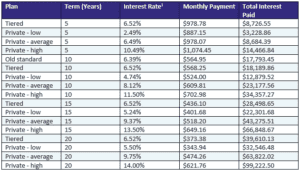
[1] Sample rates as of June 30, 2026
Repayment Assistance Plan (RAP)
Under this income-driven repayment plan, monthly payments are limited to 10% of discretionary income and adjusted based on the number of dependents.
How RAP’s interest waiver works: Suppose you have a $50,000 federal student loan and your monthly RAP payment comes out to $150. If the interest accruing that month is $292, your $150 payment would first apply to interest. The remaining $142 of interest would be waived instead of being added to your balance. In other words, the loan would not keep growing just because your required payment was too small to cover the full interest charge.
How RAP’s principal match works: RAP also tries to make sure you are actually reducing principal. If your monthly payment would leave less than $50 going toward principal, the Department of Education would contribute enough so that at least $50 is applied to principal each month. That means even at the minimum payment, your balance still decreases.
RAP is designed to stop unpaid interest from compounding and to guarantee some principal reduction each month. Under the plan, borrowers would still have a maximum repayment window of 30 years.
Example Scenario, RAP Payments by Starting Income (3% Annual Raises)

Walking Through the $60,000 Borrower
The press talks a great deal about loan forgiveness, but how does it actually play out on a $50,000 loan?
For a single filer earning $60,000, discretionary income is calculated as income minus 225% of the poverty line, approximately $26,880. That leaves discretionary income of $33,120 per year, or $2,760 per month. The resulting RAP payment is $276 per month, compared with the standard payment of $568 per month.
If this individual remained single and received 3% salary increases each year, their payment would rise over time, and they would reach the 30-year forgiveness point with a remaining balance forgiven (assuming they stay on RAP and make all required payments). Over the full 30-year RAP term, total payments would run toward the figures shown in the scenario table above, with the remaining balance forgiven at the end.
The Bottom Line
For a $50,000 borrower who values flexibility and wants to keep federal protections, the new Tiered Standard plan is an improvement over the old mandatory 10-year term, offering lower payments, more options, and access to RAP’s interest relief.
A private refinance can lower the rate for well-qualified borrowers, but it trades away the federal safeguards that protect borrowers during financial hardship.
A Critical Caveat on Refinancing
Refinancing federal loans into a private loan is a one-way door. The moment federal debt is refinanced privately, the borrower permanently forfeits federal benefits, including: income-driven repayment and the new RAP interest waiver; the $50 monthly principal-matching benefit under RAP; and federal deferment, forbearance, and any future loan-forgiveness programs.